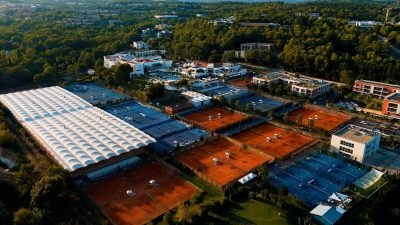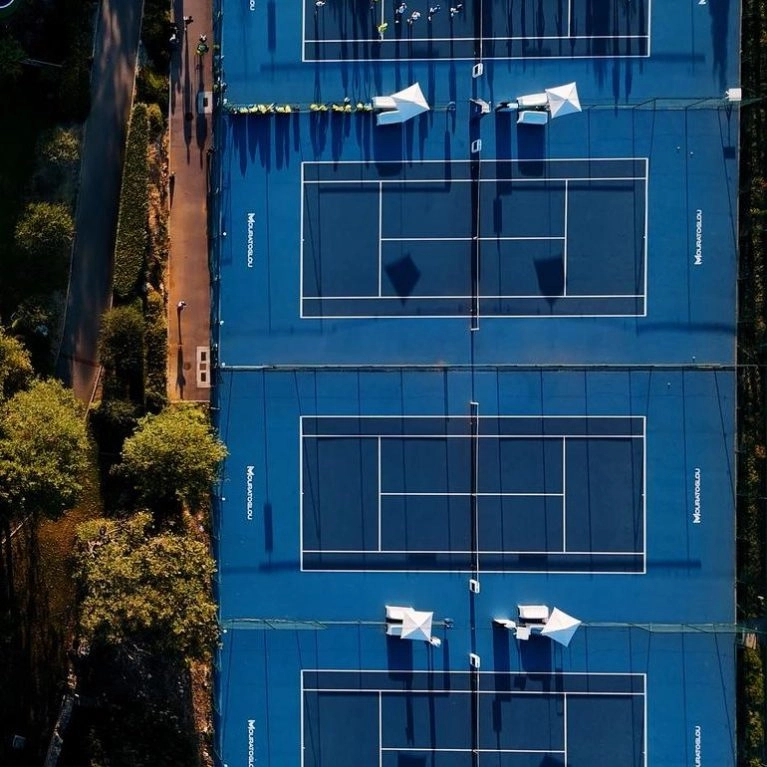
At the Mouratoglou Academy, every detail counts in elevating your tennis game.
Our clay and hard court surfaces are designed to faithfully reproduce the conditions of major international tournaments.
Thanks to a complete renovation of our courts between 2025 and 2026, every player will benefit from modern, high-performance courts that are perfectly maintained. Each court has been designed to offer a realistic, precise and demanding experience. The surfaces meet the standards of major tournaments, guaranteeing training conditions comparable to those of the most prestigious tournaments.
Whether you’re preparing for a clay-court season or looking to hone your game, our facilities allow you to train like the pros in an exceptional setting, working on every detail: bounce, serve, positioning and strategy.
Grand Slam quality clay
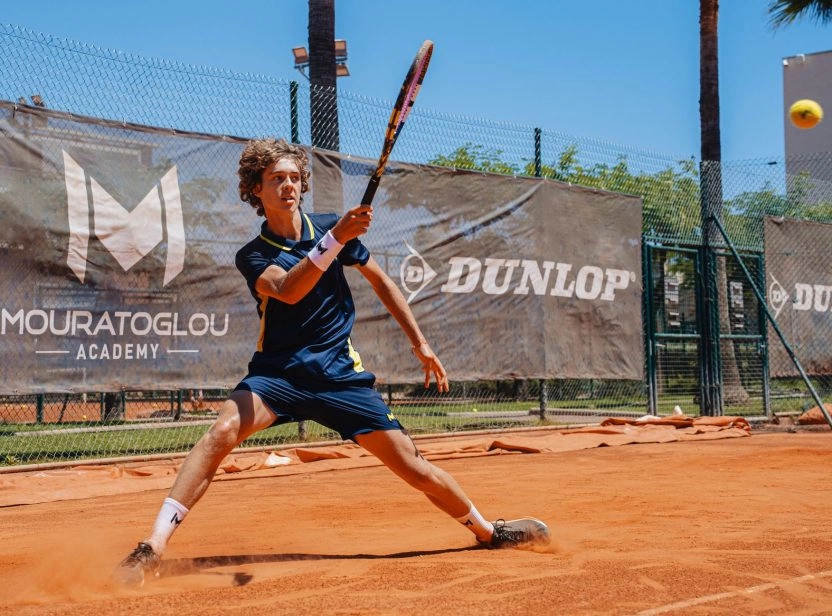
the surface of an intelligent, enduring and strategic game
Grand Slam quality clay is much more than a classic clay court: it’s a school of tactics, endurance and rhythm control. At the Mouratoglou Academy, our clay courts have been designed according to the same criteria as those used at the legendary Paris Grand Slam, the world benchmark for clay-court tennis.
This slow surface encourages point building, time management and the development of thoughtful play. On clay, rallies are often long and strategic.
Each point is won through patience, precision and the player’s ability to impose his tactics. The high, controlled bounce on this surface requires perfect reading of the game and excellent physical preparation. Clay puts great demands on endurance, forcing athletes to maintain a high level of concentration and consistency throughout the rally.
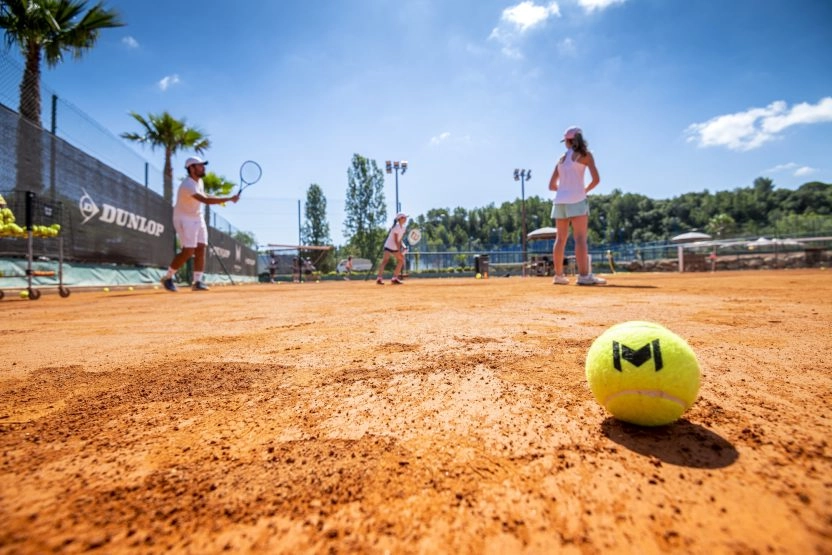
The specific characteristics of clay courts :
- Increased endurance: long exchanges develop physical and mental fitness.
- Tactical play: each shot is part of an overall strategy, with intelligent placement and varying trajectories.
- Bounce management: clay slows the ball down and makes it bounce higher, requiring anticipation and precision.
- Rhythm and tempo: the surface teaches you to control the speed of your game and exploit every area of the court.
- Tournament preparation: daily training on this surface prepares you to perform at the highest level, where clay is still a must.
- Service work: on clay, the serve becomes a strategic opening weapon.
Training on clay means learning to train like the pros: building, anticipating, varying and resisting. This unique surface produces complete players, capable of adapting to any situation and imposing their rhythm at every tournament.
Hard ground
the surface of speed, rapid rebound and precision
The hard courts at the Mouratoglou Academy meet ITF and ATP/WTA standards, similar to those used in the biggest competitions.
On this fast surface, the game of tennis gains in intensity: exchanges are shorter, decisions are more immediate, and every bounce is decisive.
Players learn to exploit the speed of the court, anticipate rebounds and control their serve to set the pace.
The aim is to develop reactivity, power and speed of execution.
This surface is ideal for building an attacking, precise and modern game, in line with the demands of professional tennis.
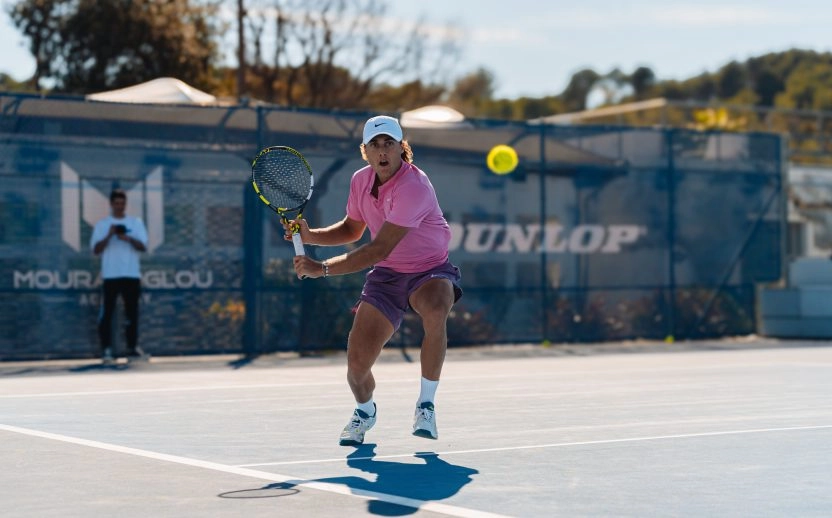
The advantages of hard terrain:
- Developing the speed of the game and taking the initiative
- Master a fastrebound and a more dynamic game
- Strengthen support and stability on a reactive court
- Work on the transition between defence and attack
- Optimise the serve to take control of the point
Training on a fast surface means learning to adjust your movements, anticipate the rebound and take control from the very first shot.
This approach allows you to train like the pros and adopt the tactical patterns used on the ATP/WTA circuits.
Mouratoglou methodology

The Mouratoglou methodology is based on a strong conviction: each player is unique. The aim is to reveal each player’s potential through a tailor-made approach based on observation, understanding and continuous improvement.
The coaches use cutting-edge technological tools and analyses of play, rebound, service and positioning to develop a complete and intelligent game.
This philosophy is shared by all the coaches trained at the Academy, many of whom have coached professional players on the ATP and WTA tours.
Why choose the Mouratoglou Academy?
Exceptional facilities
The Mouratoglou Academy offers a unique setting in Europe, with 33 courts including several clay and hard courts, a top-of-the-range physical preparation centre, recovery facilities and equipment to the highest standards.
Each court is designed to provide optimum bounce and realistic playing conditions, similar to those encountered at major tournaments.
Elite coaching
Coaching is provided by certified coaches, trained in the Mouratoglou methodology and experienced in training professional players.
Each player benefits from individual monitoring, combining video analysis, tactical support and mental coaching, to help them achieve their goals on every tennis surface.
An ideal climate for progress
Located on the Côte d’Azur, the Academy enjoys a mild, sunny climate all year round, so you can train like the pros without interruption, on clay or hard court.
An international reputation
Recognised throughout the world, the Mouratoglou Academy has trained and coached many ATP and WTA players, thanks to its demanding, human and performance-oriented approach.
Choosing the Mouratoglou Academy means joining a world tennis institution where excellence, innovation and passion guide every session.
“Champions never look back” – Patrick Mouratoglou
FAQ
-
Clay is a slow surface that favours tactics, long exchanges and rebound control.
Hard courts offer a faster pace of play, ideal for accurate serving and shorter points. -
Training on different tennis surfaces allows you to develop a complete game, adapt to different rebounds and progress more quickly.
It’s the key to training like the pros and succeeding on the ATP circuit. -
Yes, players have full access to the clay courts of standard Grand Slams and to the hard courts.
-
Each court complies with the official ITF dimensions: 23.77 m long by 8.23 m for singles, 10.97 m for doubles.